Showing posts with label basil. Show all posts

Thursday, May 10, 2012

Basic Permacultural Forays

Finally did something interesting that warranted a post again! This time on the soil front.  Over the past few months I have been doing some mild research into permaculture, complimentary plantings, traditional practices and the like, and this season had the chance to try some things out in our garden.  The first thing is a new style of corn cultivation.  In past years, we did the basic rows, and while we certainly have had some very fruitful years, I always have believed that grain cultivation in general (corn less so, but still) is very inefficient in its use of space.  So this year we decided to go the traditional route, and try growing our corn in hills.  And then we took it a step further, putting our squash plants in the middle of the hill, so they will fill out the ground beneath corn, utilizing multiple vertical layers of growing space in the given ground space.  And still plan to take it another step further, by adding pole beans into the mix once the corn has reach 6" or so, effectively using the corn stalks as poles for the bean vines to grow up (hopefully) utilizing yet another layer of grow space in the given ground space.  So in the long run, we hope to get three crops from one 6' x 10' plot of our garden.  I made six hills, all planted with eight corn stalks around the outer ring of the hill, and three squash plants in the middle (two hills are spaghetti squash, the other four ar butternut), we will probably pull/ transplant a couple of those plants once we know how many sprout, but that is the initial.  And I have yet to definitively decide, but at the moment am planning on 1:1 bean:corn.  
On a minor side note, this was also inspired by our lack of space left for corn, after half of our potato patch from last year (even at half a large piece of our garden) re-sprouted from potatoes (accidentally) left in the ground last year.
You can see the potatoes just to each side of he hills.  Will post more pictures as these fill out.

Also inspired by my boredom with row planting, and by my brother's quickly approaching wedding, I planted our lettuce with a little more creativity this year.  Hoping it will fill out just in time for when we have guests in a week from now.


Also, we have added yet a few more plants to our permaculture (perma being short for permanant) repertoire.
Raspberry canes just beginning to sprout.  These will become an approximately 2' wide thicket over the next couple of years.
 And asparagus, which could technically have been harvested this year, but is better to be left to establish for a year, hence the lankyness.
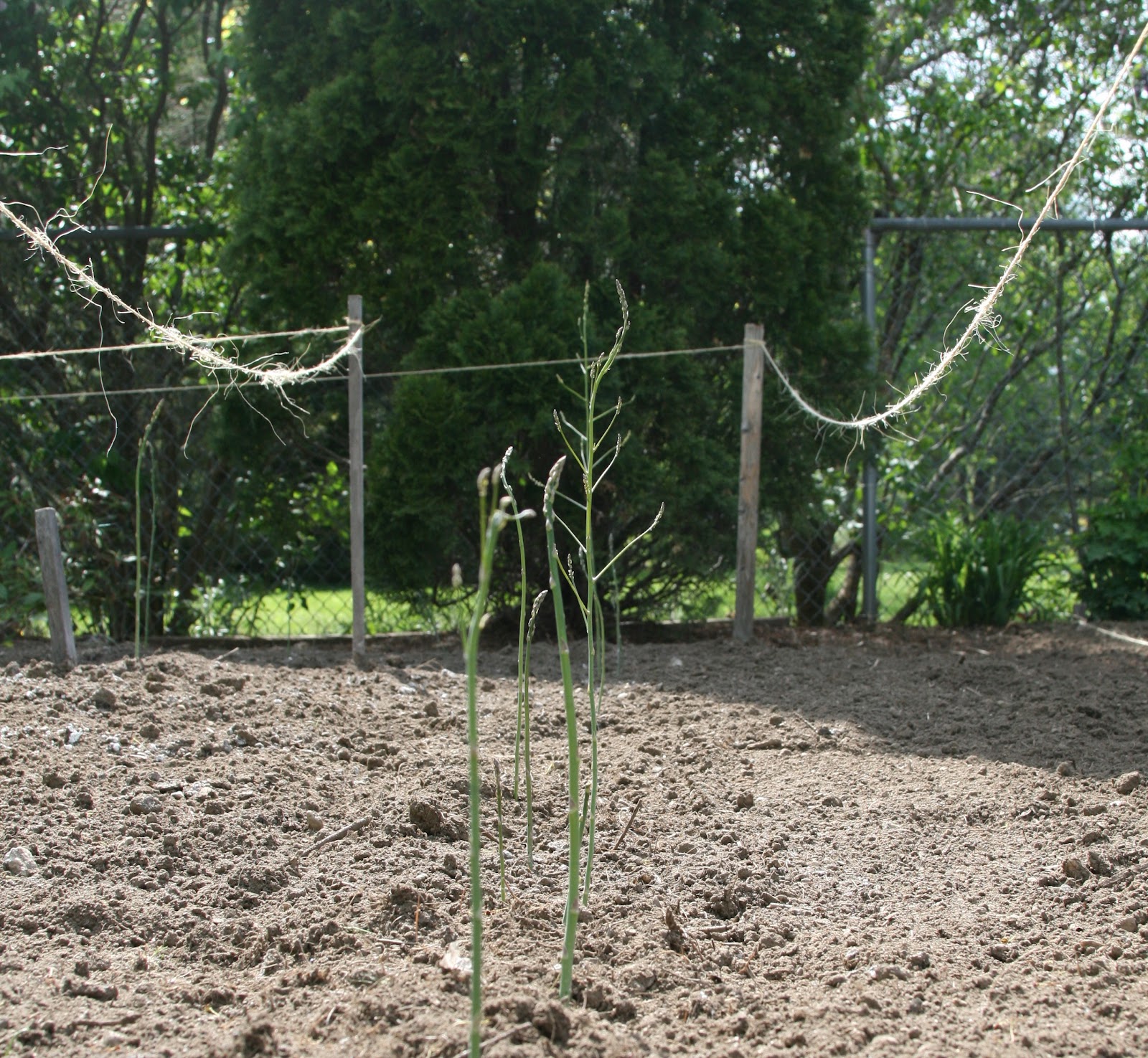
 And this is what asparagus becomes if not harvested!
 And this isn't new, but the strawberries really took over this year, most of them are already flowering and fruiting from our unseasonably warm spring.  Plan to grab a few to reattempt growing them hydroponically, see if I can't conquer my mite problem. And those blueberries are starting to really fill out! Just hope the birds don't eat them all this year!

Now the benefits of permaculture are diverse, and there is a whole (growing) school of thought surrounding these benefits, and the ways to implement come in a wide range of methods.  Everything from hydroponic systems that utilize aquaponics, and complimentary plants on a small scale, to edible forest gardens where people spend years establishing a plot of land as a hearty ecosystem that is also very fruitful relative to a natural untamed plot.  There are tons of principles that go into these different methods, and depending on the goals, the means change just as much if not more.  But things like thinking of how to best utilize a plot of land (i.e. looking at vertical layers, complimentary plantings).  How to best reduce input into the ecosystem (i.e. using aquaponics or vermiculture [worms] as a nutrient source, complimentary plantings as pest deterrents).  Reducing carbon loss in the soil (i.e. not tilling or burning, increasing composting). Increasing soil retention of water and nutrients (also not tilling, but also introducing fungal growth in the root zone).  And utilizing multiple points from the ecosystem (plants but also animals and fungi).
One thing I have been getting really interested in as of late is mycorrhizal fungi.  I was given a sample of Extreme Gardening's Mykos recently, which is essentially the spores of one type of these fungi, and it spurred my research mode.  So I looked into what the benefits of this type of inoculation is, and even the off hand benefits are fantastic.  Basically, these fungi come in a variety of types, and you could probably spend your life researching them, but they generally create a complimentary relationship with the root systems of different plants.  They grow around, or connected to the root hairs.  And because of the biology of fungi, they are able to effectively increase the surface area of water and nutrient uptake to the root system, simply because fungal mycelium (kind of like fungal 'roots') are smaller than even the smallest root hairs.  They also have the benefit of increasing water retention, can process otherwise inaccessible minerals into forms the plants can use, and in some cases can act as a buffer/ bank for some nutrients that would otherwise wash away in the rain (phosphorous comes to mind).  All around leading to fuller, healthier soil systems and plants!  And occasionally you can find an edible fruiting type, so all the more potential for food production.  These can also be used in hydroponics, though I am just trying it out now, so I'll have to let you know how it turns out.


And on the hydroponics front! Nothing particularly new compared to last year (aside from the mykos inoculation). Though I have added a new supplement to my nutrient solution that is focused on root growth and health.  Interestingly it contains brewer's yeast, which I would have previously assumed would damage the roots (in fact once one of my systems started to smell faintly like a brewery and I hastily changed the water because of it), but apparently not, so I will have to do a little research on that. But my plants seem to be loving it, they are only a week or two established in these pictures and they are loving it.
This year I am trying all cherry tomatoes in this system, straight DWC this time. Varieties are yellow pear, polar baby, and a traditional red cherry. So we will see which does best.

Went for a jalapeƱo pepper rather than bell this year, hoping that a smaller pepper will be more fruitful in the system.  Circled in sweet basil.  And cilantro is expected for the last spot, if/ when they sprout.

And my pineapple plant! (Or ananas plant as most other languages would call it...)
It is probably 10 months since I put the cutting in my system last year, and has been loving life since the sun came out a few weeks back.  And I changed the water/ cleaned the bucket for the first time in over a year, and since it looks healthy as ever, new growth is hearty and a nice deep green.  Still a ways to go before it would fruit, but at this rate, I am hoping!


And on a side note, the other day when I was looking through our seedlings I found this little guy hanging out in one of our seed starter trays, inside of our sun porch.  Lucky for him though, he avoided a chilly night, and I noticed him and set him free before he became dog food.


Be well wonderful readers, Namaste.

Wednesday, November 16, 2011

Summer Successes


So I have been super awful at keeping up with my endeavors online since things went awry in the spring, but I have continued endeavoring! And over the course of the summer my family and I have had a few successes despite some crazy weather for MA (We had perpetual rain for some weeks, tornadoes, hail, hurricanes, early frosts, and snow in october!).
The three tomato plants that I started in the spring are probably what did the best of anything. At their peak I was harvesting a large bowl full of heirloom tomatoes daily! They were super delicious. Up until earlier this year I never ate tomatoes, even on anything, and I would eat the yellow pears right off the vine daily. The yellow pears were the most prolific of the three by far, my speculation is that it was because of the placement of the plants in the system; the yellow pear was in the center, directly over the primary of the two airstones I had in the system, and the most area to grow due to the shape of the basin which the water was in. Aside from the fogger, which was removed mid-season, the system contained no plastics whatsoever. It is hard to see in the pictures, but I built a support cage out of chicken mesh, and used an old shovel handle to hold the plants up.
These first two pictures are from just before, and just after moving from inside to outside.
They took a bit of a beating, especially the yellow pear (center/ tallest). Taken in late May.

These are from a couple days, and about a month later

After some overzealous branching up  top in late July, my tying up gave way and the whole bush started to fall over, so I put a 12 foot 2"x4" in the ground next to it and began tying it up.  It reached about eight or nine feet before we got hit by a hurricane, and some sort of a mold/mildew/fungus took out all of the tomatoes in the area.
Also in this system, I rooted my new pineapple plant!


Next to the tomatoes, the other hydroponic things did pretty well. A DWC system which I had set up for my mom in the spring, which had three basil plants and a pepper produced a number of peppers and good deal of basil, though the pepper overshadowed a little. This system survived hell, the pepper plant, and even the whole system were blown over multiple times, causing branches to break off. There was also a twelve site fog culture planted with two peppers and eight or so basil plants of assorted varieties. It was not the best fogger system set-up, a lot of sediment built up on the fogger which clogged it. But none the less it was very bountiful, we made multiple pesto dishes throughout the summer simply through picking little bits off, and then when we really harvested, we made dozens of 4-8oz jars of pesto with it.
All of these pictures are from very early in the season, by the end everything was much larger.
Before move outside.

After move outside.


Though I shelved my indoor systems for the summer, I did set up one simple, experimental ‘garden’. I built a table out of scrap wood we had laying around and cut two holes in it the size of a five gallon bucket. Then I built something of a light box around it, and lined it with reflective film on all sides. I planted five basil plants in each bucket, placed one new airstone in each bucket, fed by the same pump. If I had light on, it was equidistant from each bucket. The one difference between the two buckets was that in-line to the airstone of one bucket I placed an algaculture relay system. In theory, via passing the air through an active algaculture, the oxygen content will rise in the air relative to the external atmosphere, thereby diffusing a higher oxygen content into the DWC nutrient solution. In practice, I took a clear mason jar, drilled two holes in the lid, ran a line-in which was to be submerged in nutrient water (to the bottom of the jar), then ran a line-out which was mounted just enough into the jar to be sealed, this was all sealed air tight with hot glue (silicon caulk in the future), the jar was filled with nutrient water leaving a small gap, I inoculated the solution with algae from a fish tank, and the lid was tightened on. The plants in each bucket grew equitably while the jar was establishing. It took a while to get established, but eventually the jar was a vibrant green and all surfaces were thick with algae. I then cut all plants back to the base-most node placing them on the same level literally and figuratively. Effect, after leaving them to grow freely all summer, the plants in the inline-algaculture-bucket were substantially taller, approx. 140% taller (~ 4-6 in.). I don’t consider this at all definitive, and I will likely try the experiment again, multiple times, before I am positive it is beneficial. The idea being that as with all life, plants use oxygen, especially at night, especially in the roots, so increasing the atmospheric oxygen in the root zone would potentially increase growth in some capacity. Whatever the end result, these plants produced wonderfully. Unfortunately it was too close quarters to get any good photos.
This is all of the basil we grew, inside/outside, soil/hydroponics from the night we made pesto.
Top is from soil plants.
Bottom left is outdoor DWC.
Bottom right is from my experimental DWC.
Now for the soil. It was super wet this year, and as I previously said we had some intense weather. But we have an extensive garden and some things did quite well. Potatoes, we grew nine different heirloom varieties, and we actually bought another fridge to store them all. The soil tomatoes (as well as the hydroponics, though earlier) were attacked by a mold, mildew, or fungus in the area and took a hit for it. Beans did okay though we had some pole beans labelled bush and vice versa, so we didn’t have the proper set-up for maximum yield. We planted strawberries, and they spread like wildfire, and produced some fruit. Onions did well, beets not so much. And as always we had plenty of lettuce, kale, chard.

This is the primary part of our soil garden, before much had sprouted.  In the center are onions, chard, lettuce, beets, spinach.  To the right of the central tree was all potatoes, ~25'x25'.  To the left of the tree out to the rope was all corn, but it didn't do fantastically.  And in the back left were our soil tomatoes. Kale and broccoli scattered everywhere.

The next picture is from what is now our berry patch off on the northern side-lot of our yard. Four blueberries, and a lot of strawberries (even more now!) this has all been covered in mesh.  Just out of frame to the left were our beans and some cucumbers.  An the picture to the right is of one of our cold-frames which we use to start plants outdoors before it is warm enough, and now to keep our lettuce alive past frosts and even snow this year.


I will likely be posting again soon, with the summer gone, and winter quickly approaching, I will be bringing much more life back indoors.  I have a few hydroponic things that I worked on, but never planted anything in due to timing which I will post some designs and pictures of.  And my WindowFarm(s) will be running and planted again in the next couple of weeks, so stay tuned, follow to be notified of any updates, and keep farmin'! Namaste.

Monday, November 29, 2010

Tower Two is Back!

With the recent holiday, I was finally able to do a little more work on mine and my parents' farms. Coming up in January I will be moving into an apartment, and reinstated this farm to bring with me, with the hope that it will be producing or at least established by move-in time. Because of this, I am going to be posting separate posts for the separate systems. The tower here is the one I will be taking, and is the inverted pyramid design (look back for a full view without plants). The major modifications that I have made to this to get it working again related to the pumping mechanism. I removed the cork from inside of the bottle, replaced the needle, and reconstructed it with the check valve outside of the bottle. I then inserted the cork int the mouth of the bottle, rather than from inside the bottle. The function of all of this was to get the pump to work more efficiently and consistently. Previously the water would stop pumping if the water level dropped minimally, due to the height of the needle within the bottle. The needle lowered 3-4", now it hardly needs any water to work. This is the same construction as Caroline's farm, pictured in the post below. I also unclogged the T junction at the top which had built up algae causing a pump malfunction. And I covered the top (clear) bottles with black fabric to block out sunlight, and prevent algae growth. And a new innovation I thought of when working on Caroline's farm that isn't pictured, but I added last minute was wrapping the holes on the drip ring with cotton fabric to prevent it from spraying off in every direction and causing water loss.
We had planted a boat load of seeds a couple of weeks ago, but unfortunately most of them didn't sprout! So I filled my farm with what did sprout, and we will be planting some more soon to fill out my parents farm.
Here are some pictures:
My two peas (in front), and two eggplant (in back).
The left bottle is full of hydroton, but no plants due to the upcoming move.
Purple basil
My three bush beans
My green basil plant.
A bunch of lanky lettuce seedings
The new neck set-up

Saturday, July 17, 2010

Prototype Success


Despite the indignant heat in the northeast this summer, and my sub-optimal location of my farm in a non-air-conditioned sun porch, the simple prototype I initially made has been relatively successful over the past few weeks. It is a simple (and fairly messily tied) single-column tower. I used the extra twine to fashion rope and attempted a few different tying styles to decide how I wanted the final model to be fashioned (me and everyone I asked decided on simple rope, with twine anchors). It is four bottles tall, and initially had a one-gallon reservoir. I had used a left over tropicana orange juice gallon jug for mixing nutrient solution in, and figured I could just poke a whole in the cap, hang it upside down over the top (empty) bottle, and let it drip. It took some finagling, but I ended up drilling a fairly large whole, plugging it with a small cork, threading a string through the cork, then covering the whole thing with wax to prevent leakage. It worked. For a while, until I had to refill the jug. Unfortunately, the cork fell apart due to too much water saturation. Luckily, it was a cool night when that happened so I wasn't worried about the plants drying out. And by the time I got up the next morning, my parents had been inspired to find a new reservoir to keep the plants nourished. We ended up with a cork in the top bottle, with a hole drilled through it, and a string through that. And that is where these pictures are from:
The three plants I have are basil, tomato, and pepper, respectively. The pepper is a little stunted because it was actually saved after we accidentally weeded it from our garden. The other two are relatively in great condition, no signs of nutrient deficiency. I have been using Foxfarm nutrient schedule, primarily the Grow Big Hydroponic and the Big Bloom. I also have some Cal-Mag Plus on hand in case of any magnesium or calcium deficiencies. My biggest issues at the moment are: too little sun, and too much sun. Too little in the sense that where this module hangs, it is inset from the south side window by 2 or so feet. I intentionally used an existing planter hook instead of putting it right in the window whilst I established the plants in the hydroponics. This has caused the plants to stretch out, reaching for the light. I also quickly realized that in the summer heat, if the dark bottles are directly hit by the sun, they heat up and quickly dry out the medium and cause nutrient build-up (this is what I meant by too much sun). In the winter, I am actually hoping that some of the heat build-up will help keep the plants at a more suitable growing temperature while near windows. I have resulted to hand watering when I put the plants in direct light, in order to keep them moist. All in all it has gone very well, and remained very simple throughout this first attempt. I have since transferred these plants to the newer design I have created based on an idea my friend had. I have added three net-pots with lettuce, though the heat is oppressive and I had a few mishaps while transplanting them. So far they have stayed alive, I am hoping they establish themselves quickly. I have also been putting together more tutorial sheets that explain how I assemble things. I will be posting pictures of the new farm soon, but for now you can see this one at least!
And for a taste of things to come: