Showing posts with label prototype. Show all posts

Tuesday, January 8, 2013

Some Summer Updates


Hello again! It has been a busy few months since last summer, in non-horticultural areas of my life (looking for and starting a new job being a big part), but I have been sitting on a bunch of pictures from a project I had worked on for a while and finally put into action last summer without a great deal of success.  None the less, I will share with you one big design failure. Though I will say while this particular iteration was unsuccessful, I am hopeful many pieces of this can be reused.

My goal was to build a free standing, plastic free, vertical, drip driven berry patch (mostly using strawberries, but with intent to add raspberries, and maybe blueberries once I stabilized it...)  And while in the short term the design worked, later due to what I have assumed to be a poor material choice, and inadequate monitoring of my nutrients, the plants succumbed to incapacity to thrive, and eventually most died off before I decommissioned the whole structure.  None the less there were a few cool parts to talk about, and up until everything started going brown I took a number of pictures, so let's look at the highlights!

As it always does, it started with an idea, this particular idea being for a check valve lift mechanism, rather than the ball inflation needle design I had used in the past.  The theory being without the possibility of backflow due to increased pressure with increased height, this could lift higher easier. If the only way out is up, then up the water and air must go, right?

My ideas often become drawings:


Then I find materials, and my ideas get simpler:

Then I run into issues, like it not working. And I tweak to get it to where I want.  This alteration being that I cut the piping between the check valve and the T joint, and added a 4"piece of 1/4" copper tubing, as small reservoir. It worked:


So I had this new pump mechanism, this was back when I had the Pentatower going, but I didn't trust it there because it was untested, and I was a little skeptical.  So I had this dirty old galvanized trashbin at my apartment, and sitting on the deck one day I thought it might be a good reservoir. So I got a clean one, and caulked all of the seems with silicone. 
This more than anything else was the poor material choice,  by the end it had rusted (but the seams were good!), and while it wasn't structurally at risk I suspect that there may have been toxic levels of iron in the solution.
 
Punched a whole in the center of the bottom.

Did this:

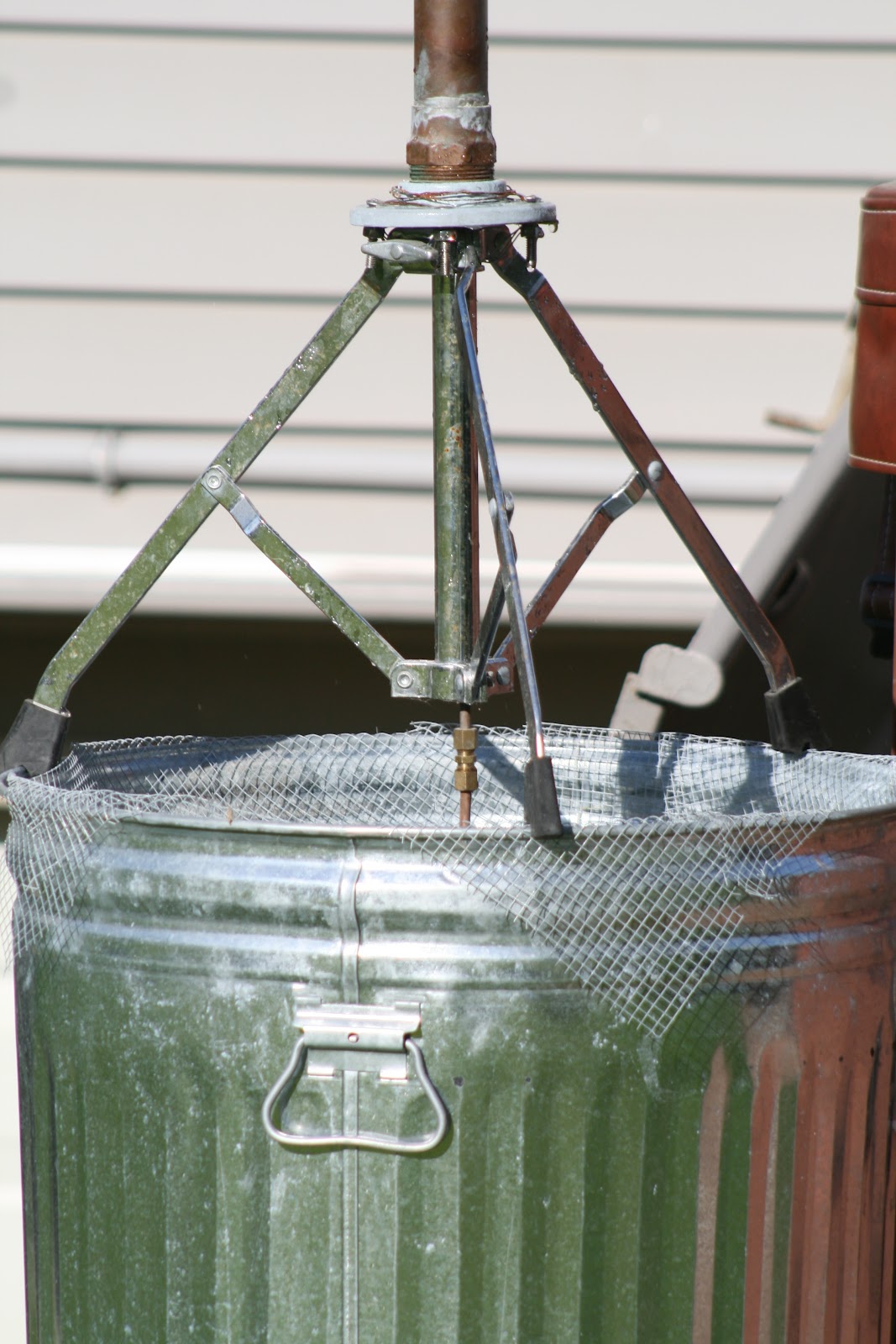
And there it sat for a bit, until one day I was cleaning up some things, and found this old tripod, formerly the base of a drum kit cymbal stand, which had lost its matching pieces.  Oh and I made a giant net pot out of 1/4" steel mesh.

And so it sat for about a year, I put some water in it to check for leaks, there were none.
Put some air stones in it to prevent stagnation. Put a lid on it, and left it in the summer of 2011. I just didn't know what to do next with it I was planning to suspend the pentatower from the top, but just couldn't think of how to do it. So it sat, until I remembered I had another piece of pipe like I used in my portable tower, which I thought would sit nicely on top of the tripod. It did, I stabilized with some insulating foam strips coiled around the base, and made a cut out of the lid to use as an umbrella of sorts to keep water of the iron wire I used to anchor the base:

Giant net pot, connected the lift tube:

It worked! This thing was easily 7-8' of lift, and it had no trouble, even with low pressure due to long air lines:

So me and my friend stared at it for a bit and eventually had a couple ideas that seemed interesting, so I went with it.  Whole thing, made a cone thing out of mesh:

Filled 'er up (over 5 gallons of hydroton) and cut little inverted Ts in the mesh to make planters:

And put in the berries!

And so it was for weeks, the plants did great at first, then they started looking a little iffy, the airline got detached for a day at one point, and then it was all down hill.  Plants dropped like flies, turning vibrantly red first.  And around this time I realized how impossible the idea of a water change was...  I will also mention that while I stopped taking pictures at this point, I also put berries in the giant net pot, with a fogger in the reservoir, though it wasn't air tight, so everything outside of the drip ring from the 'umbrella' dried out on a hot day.  And in the end when I disassembled everything there was A LOT of corrosion everywhere, so changing water was at least necessary.  Also not having a good way to monitor nutrient levels was a problem with rain, and hot days skewing my conception of water::nutrient usage.
While I did not produce anything, I still think the pump mechanism was great and will use it again.  The cone tower thing, well that I am up in the air about, I may give it another go.  The tripod, detachable, scalable lift tube is definitely a keeper, I could potentially put the pump mechanism directly at the bottom, drop it at the shores of a lake and call it a day.  And who knows, maybe with the right coating (wax maybe?) the galvanized been could work too.  Just a perfect storm of issues this time around.


In other news!

10 foot tall tomato plants!  And some awesome daily harvests from the soil:


Our compost sprouted tomatoes, and then our whole garden did! And those raspberries really took off!


And my pineapple is unwieldy. No fruit yet, hopefully in the next 6 mos.


Thank you for reading,
Namaste.

Wednesday, November 16, 2011

Summer Successes


So I have been super awful at keeping up with my endeavors online since things went awry in the spring, but I have continued endeavoring! And over the course of the summer my family and I have had a few successes despite some crazy weather for MA (We had perpetual rain for some weeks, tornadoes, hail, hurricanes, early frosts, and snow in october!).
The three tomato plants that I started in the spring are probably what did the best of anything. At their peak I was harvesting a large bowl full of heirloom tomatoes daily! They were super delicious. Up until earlier this year I never ate tomatoes, even on anything, and I would eat the yellow pears right off the vine daily. The yellow pears were the most prolific of the three by far, my speculation is that it was because of the placement of the plants in the system; the yellow pear was in the center, directly over the primary of the two airstones I had in the system, and the most area to grow due to the shape of the basin which the water was in. Aside from the fogger, which was removed mid-season, the system contained no plastics whatsoever. It is hard to see in the pictures, but I built a support cage out of chicken mesh, and used an old shovel handle to hold the plants up.
These first two pictures are from just before, and just after moving from inside to outside.
They took a bit of a beating, especially the yellow pear (center/ tallest). Taken in late May.

These are from a couple days, and about a month later

After some overzealous branching up  top in late July, my tying up gave way and the whole bush started to fall over, so I put a 12 foot 2"x4" in the ground next to it and began tying it up.  It reached about eight or nine feet before we got hit by a hurricane, and some sort of a mold/mildew/fungus took out all of the tomatoes in the area.
Also in this system, I rooted my new pineapple plant!


Next to the tomatoes, the other hydroponic things did pretty well. A DWC system which I had set up for my mom in the spring, which had three basil plants and a pepper produced a number of peppers and good deal of basil, though the pepper overshadowed a little. This system survived hell, the pepper plant, and even the whole system were blown over multiple times, causing branches to break off. There was also a twelve site fog culture planted with two peppers and eight or so basil plants of assorted varieties. It was not the best fogger system set-up, a lot of sediment built up on the fogger which clogged it. But none the less it was very bountiful, we made multiple pesto dishes throughout the summer simply through picking little bits off, and then when we really harvested, we made dozens of 4-8oz jars of pesto with it.
All of these pictures are from very early in the season, by the end everything was much larger.
Before move outside.

After move outside.


Though I shelved my indoor systems for the summer, I did set up one simple, experimental ‘garden’. I built a table out of scrap wood we had laying around and cut two holes in it the size of a five gallon bucket. Then I built something of a light box around it, and lined it with reflective film on all sides. I planted five basil plants in each bucket, placed one new airstone in each bucket, fed by the same pump. If I had light on, it was equidistant from each bucket. The one difference between the two buckets was that in-line to the airstone of one bucket I placed an algaculture relay system. In theory, via passing the air through an active algaculture, the oxygen content will rise in the air relative to the external atmosphere, thereby diffusing a higher oxygen content into the DWC nutrient solution. In practice, I took a clear mason jar, drilled two holes in the lid, ran a line-in which was to be submerged in nutrient water (to the bottom of the jar), then ran a line-out which was mounted just enough into the jar to be sealed, this was all sealed air tight with hot glue (silicon caulk in the future), the jar was filled with nutrient water leaving a small gap, I inoculated the solution with algae from a fish tank, and the lid was tightened on. The plants in each bucket grew equitably while the jar was establishing. It took a while to get established, but eventually the jar was a vibrant green and all surfaces were thick with algae. I then cut all plants back to the base-most node placing them on the same level literally and figuratively. Effect, after leaving them to grow freely all summer, the plants in the inline-algaculture-bucket were substantially taller, approx. 140% taller (~ 4-6 in.). I don’t consider this at all definitive, and I will likely try the experiment again, multiple times, before I am positive it is beneficial. The idea being that as with all life, plants use oxygen, especially at night, especially in the roots, so increasing the atmospheric oxygen in the root zone would potentially increase growth in some capacity. Whatever the end result, these plants produced wonderfully. Unfortunately it was too close quarters to get any good photos.
This is all of the basil we grew, inside/outside, soil/hydroponics from the night we made pesto.
Top is from soil plants.
Bottom left is outdoor DWC.
Bottom right is from my experimental DWC.
Now for the soil. It was super wet this year, and as I previously said we had some intense weather. But we have an extensive garden and some things did quite well. Potatoes, we grew nine different heirloom varieties, and we actually bought another fridge to store them all. The soil tomatoes (as well as the hydroponics, though earlier) were attacked by a mold, mildew, or fungus in the area and took a hit for it. Beans did okay though we had some pole beans labelled bush and vice versa, so we didn’t have the proper set-up for maximum yield. We planted strawberries, and they spread like wildfire, and produced some fruit. Onions did well, beets not so much. And as always we had plenty of lettuce, kale, chard.

This is the primary part of our soil garden, before much had sprouted.  In the center are onions, chard, lettuce, beets, spinach.  To the right of the central tree was all potatoes, ~25'x25'.  To the left of the tree out to the rope was all corn, but it didn't do fantastically.  And in the back left were our soil tomatoes. Kale and broccoli scattered everywhere.

The next picture is from what is now our berry patch off on the northern side-lot of our yard. Four blueberries, and a lot of strawberries (even more now!) this has all been covered in mesh.  Just out of frame to the left were our beans and some cucumbers.  An the picture to the right is of one of our cold-frames which we use to start plants outdoors before it is warm enough, and now to keep our lettuce alive past frosts and even snow this year.


I will likely be posting again soon, with the summer gone, and winter quickly approaching, I will be bringing much more life back indoors.  I have a few hydroponic things that I worked on, but never planted anything in due to timing which I will post some designs and pictures of.  And my WindowFarm(s) will be running and planted again in the next couple of weeks, so stay tuned, follow to be notified of any updates, and keep farmin'! Namaste.

Saturday, July 17, 2010

Prototype Success


Despite the indignant heat in the northeast this summer, and my sub-optimal location of my farm in a non-air-conditioned sun porch, the simple prototype I initially made has been relatively successful over the past few weeks. It is a simple (and fairly messily tied) single-column tower. I used the extra twine to fashion rope and attempted a few different tying styles to decide how I wanted the final model to be fashioned (me and everyone I asked decided on simple rope, with twine anchors). It is four bottles tall, and initially had a one-gallon reservoir. I had used a left over tropicana orange juice gallon jug for mixing nutrient solution in, and figured I could just poke a whole in the cap, hang it upside down over the top (empty) bottle, and let it drip. It took some finagling, but I ended up drilling a fairly large whole, plugging it with a small cork, threading a string through the cork, then covering the whole thing with wax to prevent leakage. It worked. For a while, until I had to refill the jug. Unfortunately, the cork fell apart due to too much water saturation. Luckily, it was a cool night when that happened so I wasn't worried about the plants drying out. And by the time I got up the next morning, my parents had been inspired to find a new reservoir to keep the plants nourished. We ended up with a cork in the top bottle, with a hole drilled through it, and a string through that. And that is where these pictures are from:
The three plants I have are basil, tomato, and pepper, respectively. The pepper is a little stunted because it was actually saved after we accidentally weeded it from our garden. The other two are relatively in great condition, no signs of nutrient deficiency. I have been using Foxfarm nutrient schedule, primarily the Grow Big Hydroponic and the Big Bloom. I also have some Cal-Mag Plus on hand in case of any magnesium or calcium deficiencies. My biggest issues at the moment are: too little sun, and too much sun. Too little in the sense that where this module hangs, it is inset from the south side window by 2 or so feet. I intentionally used an existing planter hook instead of putting it right in the window whilst I established the plants in the hydroponics. This has caused the plants to stretch out, reaching for the light. I also quickly realized that in the summer heat, if the dark bottles are directly hit by the sun, they heat up and quickly dry out the medium and cause nutrient build-up (this is what I meant by too much sun). In the winter, I am actually hoping that some of the heat build-up will help keep the plants at a more suitable growing temperature while near windows. I have resulted to hand watering when I put the plants in direct light, in order to keep them moist. All in all it has gone very well, and remained very simple throughout this first attempt. I have since transferred these plants to the newer design I have created based on an idea my friend had. I have added three net-pots with lettuce, though the heat is oppressive and I had a few mishaps while transplanting them. So far they have stayed alive, I am hoping they establish themselves quickly. I have also been putting together more tutorial sheets that explain how I assemble things. I will be posting pictures of the new farm soon, but for now you can see this one at least!
And for a taste of things to come: