Showing posts with label plants. Show all posts

Tuesday, January 8, 2013

Some Summer Updates


Hello again! It has been a busy few months since last summer, in non-horticultural areas of my life (looking for and starting a new job being a big part), but I have been sitting on a bunch of pictures from a project I had worked on for a while and finally put into action last summer without a great deal of success.  None the less, I will share with you one big design failure. Though I will say while this particular iteration was unsuccessful, I am hopeful many pieces of this can be reused.

My goal was to build a free standing, plastic free, vertical, drip driven berry patch (mostly using strawberries, but with intent to add raspberries, and maybe blueberries once I stabilized it...)  And while in the short term the design worked, later due to what I have assumed to be a poor material choice, and inadequate monitoring of my nutrients, the plants succumbed to incapacity to thrive, and eventually most died off before I decommissioned the whole structure.  None the less there were a few cool parts to talk about, and up until everything started going brown I took a number of pictures, so let's look at the highlights!

As it always does, it started with an idea, this particular idea being for a check valve lift mechanism, rather than the ball inflation needle design I had used in the past.  The theory being without the possibility of backflow due to increased pressure with increased height, this could lift higher easier. If the only way out is up, then up the water and air must go, right?

My ideas often become drawings:


Then I find materials, and my ideas get simpler:

Then I run into issues, like it not working. And I tweak to get it to where I want.  This alteration being that I cut the piping between the check valve and the T joint, and added a 4"piece of 1/4" copper tubing, as small reservoir. It worked:


So I had this new pump mechanism, this was back when I had the Pentatower going, but I didn't trust it there because it was untested, and I was a little skeptical.  So I had this dirty old galvanized trashbin at my apartment, and sitting on the deck one day I thought it might be a good reservoir. So I got a clean one, and caulked all of the seems with silicone. 
This more than anything else was the poor material choice,  by the end it had rusted (but the seams were good!), and while it wasn't structurally at risk I suspect that there may have been toxic levels of iron in the solution.
 
Punched a whole in the center of the bottom.

Did this:

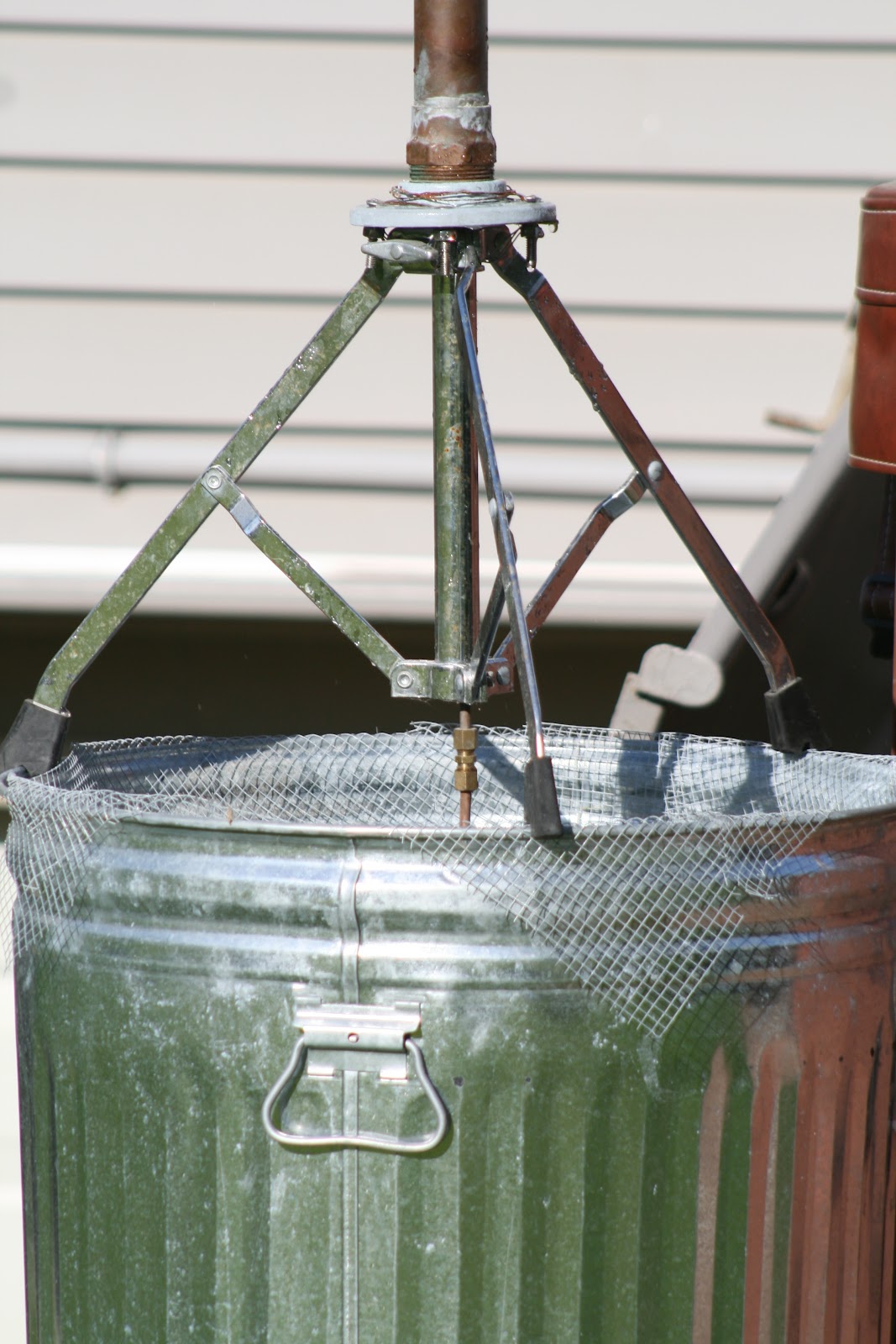
And there it sat for a bit, until one day I was cleaning up some things, and found this old tripod, formerly the base of a drum kit cymbal stand, which had lost its matching pieces.  Oh and I made a giant net pot out of 1/4" steel mesh.

And so it sat for about a year, I put some water in it to check for leaks, there were none.
Put some air stones in it to prevent stagnation. Put a lid on it, and left it in the summer of 2011. I just didn't know what to do next with it I was planning to suspend the pentatower from the top, but just couldn't think of how to do it. So it sat, until I remembered I had another piece of pipe like I used in my portable tower, which I thought would sit nicely on top of the tripod. It did, I stabilized with some insulating foam strips coiled around the base, and made a cut out of the lid to use as an umbrella of sorts to keep water of the iron wire I used to anchor the base:

Giant net pot, connected the lift tube:

It worked! This thing was easily 7-8' of lift, and it had no trouble, even with low pressure due to long air lines:

So me and my friend stared at it for a bit and eventually had a couple ideas that seemed interesting, so I went with it.  Whole thing, made a cone thing out of mesh:

Filled 'er up (over 5 gallons of hydroton) and cut little inverted Ts in the mesh to make planters:

And put in the berries!

And so it was for weeks, the plants did great at first, then they started looking a little iffy, the airline got detached for a day at one point, and then it was all down hill.  Plants dropped like flies, turning vibrantly red first.  And around this time I realized how impossible the idea of a water change was...  I will also mention that while I stopped taking pictures at this point, I also put berries in the giant net pot, with a fogger in the reservoir, though it wasn't air tight, so everything outside of the drip ring from the 'umbrella' dried out on a hot day.  And in the end when I disassembled everything there was A LOT of corrosion everywhere, so changing water was at least necessary.  Also not having a good way to monitor nutrient levels was a problem with rain, and hot days skewing my conception of water::nutrient usage.
While I did not produce anything, I still think the pump mechanism was great and will use it again.  The cone tower thing, well that I am up in the air about, I may give it another go.  The tripod, detachable, scalable lift tube is definitely a keeper, I could potentially put the pump mechanism directly at the bottom, drop it at the shores of a lake and call it a day.  And who knows, maybe with the right coating (wax maybe?) the galvanized been could work too.  Just a perfect storm of issues this time around.


In other news!

10 foot tall tomato plants!  And some awesome daily harvests from the soil:


Our compost sprouted tomatoes, and then our whole garden did! And those raspberries really took off!


And my pineapple is unwieldy. No fruit yet, hopefully in the next 6 mos.


Thank you for reading,
Namaste.

Thursday, May 10, 2012

Basic Permacultural Forays

Finally did something interesting that warranted a post again! This time on the soil front.  Over the past few months I have been doing some mild research into permaculture, complimentary plantings, traditional practices and the like, and this season had the chance to try some things out in our garden.  The first thing is a new style of corn cultivation.  In past years, we did the basic rows, and while we certainly have had some very fruitful years, I always have believed that grain cultivation in general (corn less so, but still) is very inefficient in its use of space.  So this year we decided to go the traditional route, and try growing our corn in hills.  And then we took it a step further, putting our squash plants in the middle of the hill, so they will fill out the ground beneath corn, utilizing multiple vertical layers of growing space in the given ground space.  And still plan to take it another step further, by adding pole beans into the mix once the corn has reach 6" or so, effectively using the corn stalks as poles for the bean vines to grow up (hopefully) utilizing yet another layer of grow space in the given ground space.  So in the long run, we hope to get three crops from one 6' x 10' plot of our garden.  I made six hills, all planted with eight corn stalks around the outer ring of the hill, and three squash plants in the middle (two hills are spaghetti squash, the other four ar butternut), we will probably pull/ transplant a couple of those plants once we know how many sprout, but that is the initial.  And I have yet to definitively decide, but at the moment am planning on 1:1 bean:corn.  
On a minor side note, this was also inspired by our lack of space left for corn, after half of our potato patch from last year (even at half a large piece of our garden) re-sprouted from potatoes (accidentally) left in the ground last year.
You can see the potatoes just to each side of he hills.  Will post more pictures as these fill out.

Also inspired by my boredom with row planting, and by my brother's quickly approaching wedding, I planted our lettuce with a little more creativity this year.  Hoping it will fill out just in time for when we have guests in a week from now.


Also, we have added yet a few more plants to our permaculture (perma being short for permanant) repertoire.
Raspberry canes just beginning to sprout.  These will become an approximately 2' wide thicket over the next couple of years.
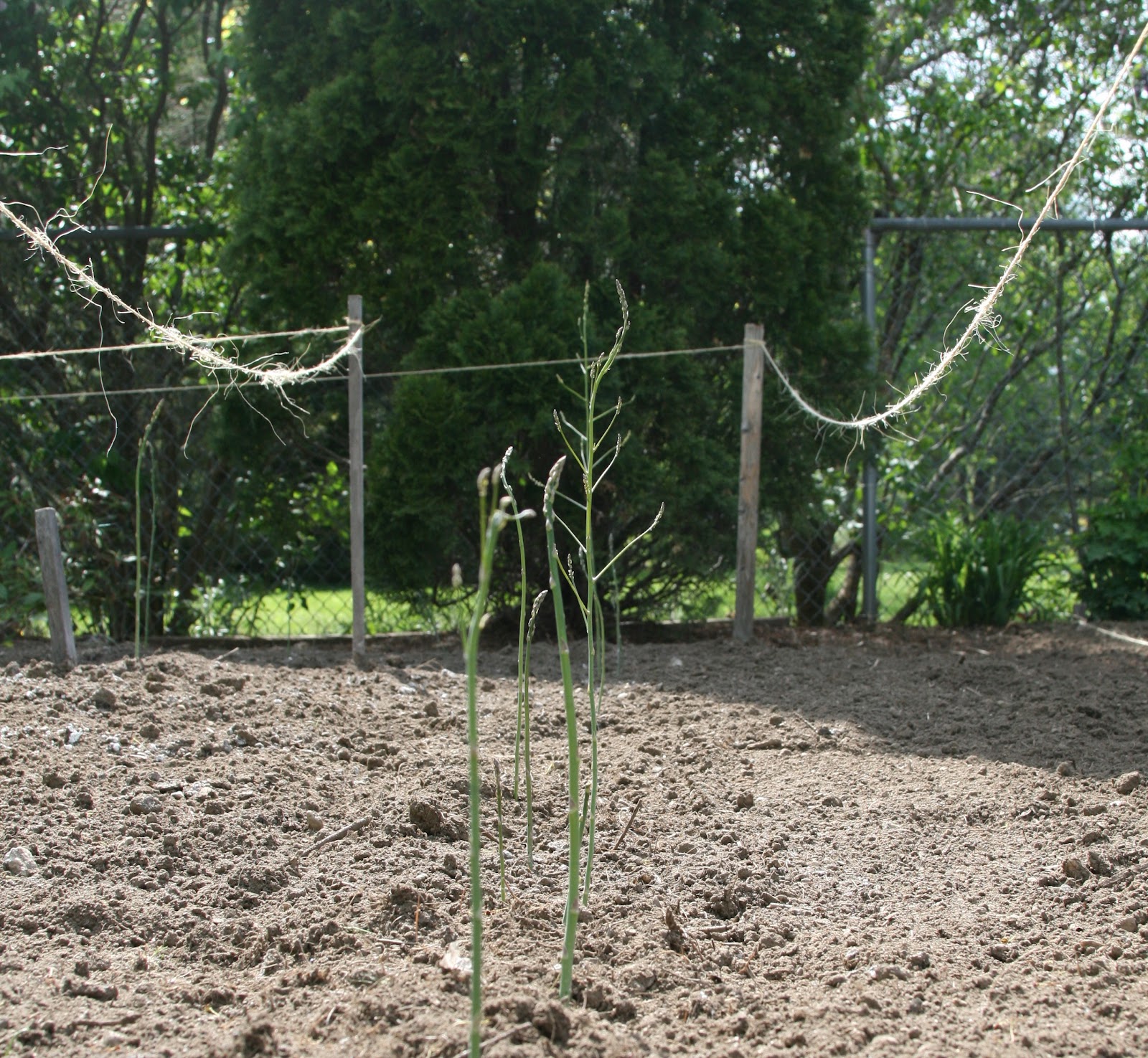
 And asparagus, which could technically have been harvested this year, but is better to be left to establish for a year, hence the lankyness.
 And this is what asparagus becomes if not harvested!
 And this isn't new, but the strawberries really took over this year, most of them are already flowering and fruiting from our unseasonably warm spring.  Plan to grab a few to reattempt growing them hydroponically, see if I can't conquer my mite problem. And those blueberries are starting to really fill out! Just hope the birds don't eat them all this year!

Now the benefits of permaculture are diverse, and there is a whole (growing) school of thought surrounding these benefits, and the ways to implement come in a wide range of methods.  Everything from hydroponic systems that utilize aquaponics, and complimentary plants on a small scale, to edible forest gardens where people spend years establishing a plot of land as a hearty ecosystem that is also very fruitful relative to a natural untamed plot.  There are tons of principles that go into these different methods, and depending on the goals, the means change just as much if not more.  But things like thinking of how to best utilize a plot of land (i.e. looking at vertical layers, complimentary plantings).  How to best reduce input into the ecosystem (i.e. using aquaponics or vermiculture [worms] as a nutrient source, complimentary plantings as pest deterrents).  Reducing carbon loss in the soil (i.e. not tilling or burning, increasing composting). Increasing soil retention of water and nutrients (also not tilling, but also introducing fungal growth in the root zone).  And utilizing multiple points from the ecosystem (plants but also animals and fungi).
One thing I have been getting really interested in as of late is mycorrhizal fungi.  I was given a sample of Extreme Gardening's Mykos recently, which is essentially the spores of one type of these fungi, and it spurred my research mode.  So I looked into what the benefits of this type of inoculation is, and even the off hand benefits are fantastic.  Basically, these fungi come in a variety of types, and you could probably spend your life researching them, but they generally create a complimentary relationship with the root systems of different plants.  They grow around, or connected to the root hairs.  And because of the biology of fungi, they are able to effectively increase the surface area of water and nutrient uptake to the root system, simply because fungal mycelium (kind of like fungal 'roots') are smaller than even the smallest root hairs.  They also have the benefit of increasing water retention, can process otherwise inaccessible minerals into forms the plants can use, and in some cases can act as a buffer/ bank for some nutrients that would otherwise wash away in the rain (phosphorous comes to mind).  All around leading to fuller, healthier soil systems and plants!  And occasionally you can find an edible fruiting type, so all the more potential for food production.  These can also be used in hydroponics, though I am just trying it out now, so I'll have to let you know how it turns out.


And on the hydroponics front! Nothing particularly new compared to last year (aside from the mykos inoculation). Though I have added a new supplement to my nutrient solution that is focused on root growth and health.  Interestingly it contains brewer's yeast, which I would have previously assumed would damage the roots (in fact once one of my systems started to smell faintly like a brewery and I hastily changed the water because of it), but apparently not, so I will have to do a little research on that. But my plants seem to be loving it, they are only a week or two established in these pictures and they are loving it.
This year I am trying all cherry tomatoes in this system, straight DWC this time. Varieties are yellow pear, polar baby, and a traditional red cherry. So we will see which does best.

Went for a jalapeƱo pepper rather than bell this year, hoping that a smaller pepper will be more fruitful in the system.  Circled in sweet basil.  And cilantro is expected for the last spot, if/ when they sprout.

And my pineapple plant! (Or ananas plant as most other languages would call it...)
It is probably 10 months since I put the cutting in my system last year, and has been loving life since the sun came out a few weeks back.  And I changed the water/ cleaned the bucket for the first time in over a year, and since it looks healthy as ever, new growth is hearty and a nice deep green.  Still a ways to go before it would fruit, but at this rate, I am hoping!


And on a side note, the other day when I was looking through our seedlings I found this little guy hanging out in one of our seed starter trays, inside of our sun porch.  Lucky for him though, he avoided a chilly night, and I noticed him and set him free before he became dog food.


Be well wonderful readers, Namaste.

Friday, November 12, 2010

Planter Changes

The last couple of weeks haven't been too great on my plants and consequently, a few of them have suffered. With the transfer back to a single system, I caused a little too much stress to some of my plants. The DWC strawberry suffered the worst, it never really established new roots after my multiple transplants, and it eventually developed spider mites. And then I caused even more stress trying to get rid of the mites, and now, well, it's spot has been filled with big cabbage from our garden that we decided wouldn't get to producing in time before winter. Also, we had a some issues with the needle on the pump clogging with sediment from the nutrients, so the plants had a few instances of dehydration, the tomato in all of it's colossal glory was hit hardest, browning at the extremities. And then I noticed last time I was home that it had acquired the mites from the strawberry, so extensively that we decided it best to remove it to save the younger, more fruitful plants, and my dad's soil tomatoes (I guess he will be winning our soil v. hydro tomato competition this time around, haha). And while the size and stability of the plants was impressive for the longest time, it did use an unnerving quantity of water, and being at the top of the tower, we were unable to have anything under it, for fear of drought. And the way I had contorted it to be supported it nearly blanketed the tower on all sides.
So, goodbye tomato, you were my first, and you put in a good run. But hey, on the plus side, your roots look really cool out of the bottle!

Along with the tomato, the basil has seen better days. After the most recent cropping, it isn't quite bouncing back like it had, being a little light choked from the tomato's dangling. So we are planning on removing that as well.
On the plus side, all three assorted peppers are doing good! The bell is ripe, albeit the fruit is a little small, but the plant is on the inner side of the tower, and the tomato was being a little fascist with the resources. And the jalapeƱos are hanging in there, they got some slight spider mites, but they are small enough we could fix it. They are flowering like it's their job though, and now that the sun has sank on the horizon, they will hopefully get the light they deserve and produce some full fruit (they were starting to fruit when I was there).

In other news, I have brought the other farm back into serviceable condition (the needle had clogged with sediment, so I replaced it with a fresh one)! And will be getting it going soon. We have seedlings popping up every day now, a wide assortment of things, including replacement basil (green and purple), lettuce, peas, green beans, eggplant, and even watermelon! I had planned on setting the farm up in my dorm room, but realize that that would just be a lot of work for no good reason, because my window gets iffy light for a couple hours in the morning right now. So I am establishing the farm at home over the next couple months, and will be bringing it with me to my new apartment in January. I will finally have a kitchen to cook and minimal time to work due to my full time student teaching, so I will be supplementing mine and my roommates grocery list with some fresh, all organic, really local veggies.
Also, in the next week or so I will be helping my friend (whom exposed me to the WindowFarms Project through a youtube video she had StumbledUpon) get a farm going in her apartment! We assembled the system weeks ago, same construction as the farm from the "My Newest WindowFarm" post. Modification is primarily that the needle is inserted from the mouth of the bottle rather than how I did it initially, so there won't be pumping issues. Otherwise it is the same. We had the bottles pre-cut, some left over from my prior incarnations, we chose nine of the twelve to use. From sanding edges smooth to hanging the system, the whole process took approximately 4-5 hours with two sets of hands. Due to school distractions and workload, as well as being in the city in the winter, it took a little bit of time for her to find seeds and then germination took an awkwardly long time to happen, but as of seeing her last they had started popping up and as soon as I have more than five minutes free outside of work, class, and projects I am going to help them get the seedlings into the system. I made her a collaborator on this blog too, so hopefully once the whole thing is established she will add some posts of her escapades.

So keep posted, between the changes in the farm I built for my parents, the reincarnation of my farm, the development of my friend's farm, and some ideas that have been jostling around my noggin during this month of work overload, there will be some more busyness for all of you wonderful readers out there to put on your palette in the coming weeks.

And please, if you guys have any input at all, comments, critiques, suggestions, requests, anything at all, do not hesitate to comment on the posts. The biggest innovations always come from multiple points of view, and my farm has only become what it is because of my friends' and family's idea bouncing, and the wonderful information and discussions on our.windowfarms.org. So, any input will be thoroughly taken to heart.

Namaste, and Keep Farmin'