Thursday, May 10, 2012

Basic Permacultural Forays

Finally did something interesting that warranted a post again! This time on the soil front.  Over the past few months I have been doing some mild research into permaculture, complimentary plantings, traditional practices and the like, and this season had the chance to try some things out in our garden.  The first thing is a new style of corn cultivation.  In past years, we did the basic rows, and while we certainly have had some very fruitful years, I always have believed that grain cultivation in general (corn less so, but still) is very inefficient in its use of space.  So this year we decided to go the traditional route, and try growing our corn in hills.  And then we took it a step further, putting our squash plants in the middle of the hill, so they will fill out the ground beneath corn, utilizing multiple vertical layers of growing space in the given ground space.  And still plan to take it another step further, by adding pole beans into the mix once the corn has reach 6" or so, effectively using the corn stalks as poles for the bean vines to grow up (hopefully) utilizing yet another layer of grow space in the given ground space.  So in the long run, we hope to get three crops from one 6' x 10' plot of our garden.  I made six hills, all planted with eight corn stalks around the outer ring of the hill, and three squash plants in the middle (two hills are spaghetti squash, the other four ar butternut), we will probably pull/ transplant a couple of those plants once we know how many sprout, but that is the initial.  And I have yet to definitively decide, but at the moment am planning on 1:1 bean:corn.  
On a minor side note, this was also inspired by our lack of space left for corn, after half of our potato patch from last year (even at half a large piece of our garden) re-sprouted from potatoes (accidentally) left in the ground last year.
You can see the potatoes just to each side of he hills.  Will post more pictures as these fill out.

Also inspired by my boredom with row planting, and by my brother's quickly approaching wedding, I planted our lettuce with a little more creativity this year.  Hoping it will fill out just in time for when we have guests in a week from now.


Also, we have added yet a few more plants to our permaculture (perma being short for permanant) repertoire.
Raspberry canes just beginning to sprout.  These will become an approximately 2' wide thicket over the next couple of years.
 And asparagus, which could technically have been harvested this year, but is better to be left to establish for a year, hence the lankyness.
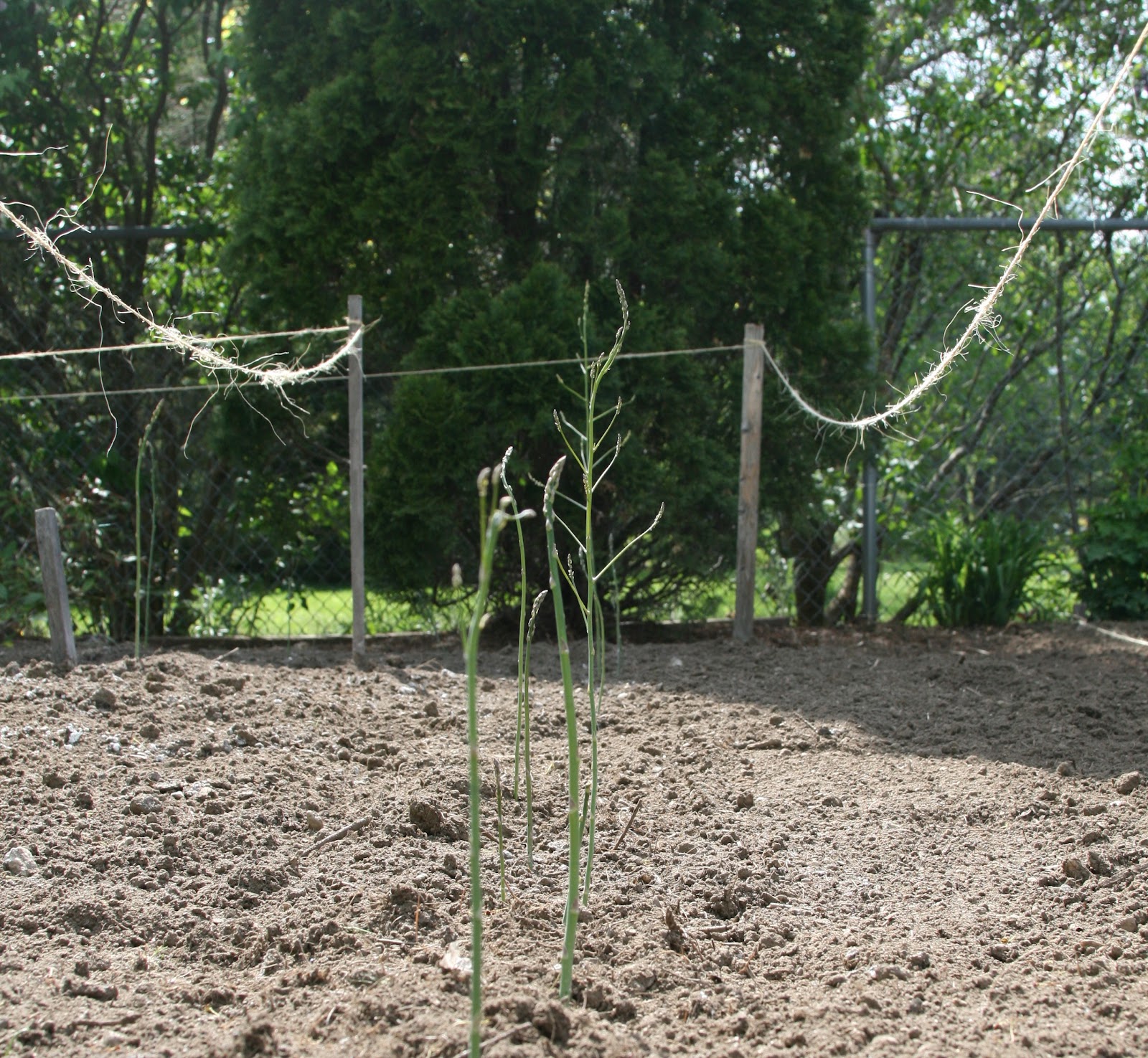
 And this is what asparagus becomes if not harvested!
 And this isn't new, but the strawberries really took over this year, most of them are already flowering and fruiting from our unseasonably warm spring.  Plan to grab a few to reattempt growing them hydroponically, see if I can't conquer my mite problem. And those blueberries are starting to really fill out! Just hope the birds don't eat them all this year!

Now the benefits of permaculture are diverse, and there is a whole (growing) school of thought surrounding these benefits, and the ways to implement come in a wide range of methods.  Everything from hydroponic systems that utilize aquaponics, and complimentary plants on a small scale, to edible forest gardens where people spend years establishing a plot of land as a hearty ecosystem that is also very fruitful relative to a natural untamed plot.  There are tons of principles that go into these different methods, and depending on the goals, the means change just as much if not more.  But things like thinking of how to best utilize a plot of land (i.e. looking at vertical layers, complimentary plantings).  How to best reduce input into the ecosystem (i.e. using aquaponics or vermiculture [worms] as a nutrient source, complimentary plantings as pest deterrents).  Reducing carbon loss in the soil (i.e. not tilling or burning, increasing composting). Increasing soil retention of water and nutrients (also not tilling, but also introducing fungal growth in the root zone).  And utilizing multiple points from the ecosystem (plants but also animals and fungi).
One thing I have been getting really interested in as of late is mycorrhizal fungi.  I was given a sample of Extreme Gardening's Mykos recently, which is essentially the spores of one type of these fungi, and it spurred my research mode.  So I looked into what the benefits of this type of inoculation is, and even the off hand benefits are fantastic.  Basically, these fungi come in a variety of types, and you could probably spend your life researching them, but they generally create a complimentary relationship with the root systems of different plants.  They grow around, or connected to the root hairs.  And because of the biology of fungi, they are able to effectively increase the surface area of water and nutrient uptake to the root system, simply because fungal mycelium (kind of like fungal 'roots') are smaller than even the smallest root hairs.  They also have the benefit of increasing water retention, can process otherwise inaccessible minerals into forms the plants can use, and in some cases can act as a buffer/ bank for some nutrients that would otherwise wash away in the rain (phosphorous comes to mind).  All around leading to fuller, healthier soil systems and plants!  And occasionally you can find an edible fruiting type, so all the more potential for food production.  These can also be used in hydroponics, though I am just trying it out now, so I'll have to let you know how it turns out.


And on the hydroponics front! Nothing particularly new compared to last year (aside from the mykos inoculation). Though I have added a new supplement to my nutrient solution that is focused on root growth and health.  Interestingly it contains brewer's yeast, which I would have previously assumed would damage the roots (in fact once one of my systems started to smell faintly like a brewery and I hastily changed the water because of it), but apparently not, so I will have to do a little research on that. But my plants seem to be loving it, they are only a week or two established in these pictures and they are loving it.
This year I am trying all cherry tomatoes in this system, straight DWC this time. Varieties are yellow pear, polar baby, and a traditional red cherry. So we will see which does best.

Went for a jalapeño pepper rather than bell this year, hoping that a smaller pepper will be more fruitful in the system.  Circled in sweet basil.  And cilantro is expected for the last spot, if/ when they sprout.

And my pineapple plant! (Or ananas plant as most other languages would call it...)
It is probably 10 months since I put the cutting in my system last year, and has been loving life since the sun came out a few weeks back.  And I changed the water/ cleaned the bucket for the first time in over a year, and since it looks healthy as ever, new growth is hearty and a nice deep green.  Still a ways to go before it would fruit, but at this rate, I am hoping!


And on a side note, the other day when I was looking through our seedlings I found this little guy hanging out in one of our seed starter trays, inside of our sun porch.  Lucky for him though, he avoided a chilly night, and I noticed him and set him free before he became dog food.


Be well wonderful readers, Namaste.

Sunday, January 22, 2012

Infestation, updates, and Rudimentary Fungiculture

For the past couple of weeks now I have had yet another infestation of spider-mites.  This time they took over my strawberry plants which had been doing very well otherwise.  Because my strawberries are perennial and I intend to have them for a while I looked into ways which I could fix the problem.  Apparently these little buggers like it to be dry, which it has gotten very much so as of late.  One solution I found was to spray a mixture of alcohol and water onto the leaves to kill the mites, then spray with water  frequently in order to prevent new spreading of the mites.  Unfortunately this didn't seem to work, so I got a product called liquid ladybugs which is also sprayed on.  As well I cut back the majority of the leaves with substantial necrotic portions to open up the space and try to remove the most affected parts.  And since I seem to have controlled the problem, so fingers crossed.  Though I did notice that some other plants in the room (just foliage house plants) the mites had spread, so I removed that as well to hopefully prevent further outbreaks.  One strange thing is that for the last month I had been growing basil in the other bucket on the table, and that never had a problem (I unfortunately didn't take any pictures before chopping it, but I did get quite a lot for only a month in the winter).


Here is a pic of it post cut back, with a couple underdeveloped strawberries. 
And a little rosemary plant to the right.


Also, I found just the right board in my shop for a table extension I have been meaning to do.  Really simple, plywood of the right dimensions, two legs that rest on another table to the left, and screwed to the top of the main table, with a hole cut for the pineapple DWC bucket.  Here are some pictures of the add-on profile, and the whole DWC table under HPS.  During the day (if it is sunny) this is the most sun-kissed area of the house, the south west corner.  With the low slung sun, these plants get decent light until about 4ish.
Simple but effective tables for my indoor sunken DWC systems.
Pineapple is doing awesome! Hopefully even better now that it is closer to the light!

Along the back you can see my alga-culture jars.  
And that big jar is a green house to increase humidity for the sage it covers.


And another little foray I am getting into is fungiculture! This time around we went simple and ordered a premade organic mushroom patch from Fungi Perfecti.  We are trying out the Shiitake (right) and Lion's Mane (left) varieties.  The Shiitake is 'open' to the air under a humidity tent mushroom caps forming across the surface, while the lion's mane remains inside of a plastic bag emerging out of holes cut in the side.  The only thing that I really have to do since a few simple initial steps is spraying with water a couple of times per day.  Though they are growing sloowwwllyyy relative to what the instructions say to expect, my guess is the dryness of the room has something to do with it.  None the less they finally seem to be forming some noticeable parts, so I snapped a picture.  We are super excited about the shiitakes with how outrageous prices are, and how delicious and nutritious they are.  Be back with results... sometime.

Saturday, December 3, 2011

DWC Strawberry

A few weeks back, in the wake of a very early snowstorm I decided I better not wait much longer before starting my hydroponic strawberries from the overabundance of runners that were sent out this season.  So I dug up five and set up my table top DWC system in a prime southern facing window.  I also set up an old HPS lamp that we had laying around to supplement the light to a full 12 hours of direct light. Now a couple of weeks later they are doing amazing, and one of them is even beginning to flower!

What I am pointing at is one of the remaining original leaves from growth outside. All of the original leaves were discolored and partially necrotic, likely a soil deficiency that we will have to fix next year.  These pictures don't really do justice to how healthy the other leaves are looking.


Something else that is doing surprisingly well is my pineapple plant!  I mentioned this very briefly in a previous post or two, but the story is I dropped the top of a store bought pineapple into my tomato system over the summer, and when I dismantled it this had fully established roots! So with my conclusion that my orange tree experiment was over (it never grew past a couple leaves), I dropped it in that bucket, and there it remains.  I just did a full water change after noticing a lighter green color in the new growth (which there is surprisingly a lot of since being out in full light).  Significant of a nutrient deficiency, which in this case was likely a result of old water throwing off the chemistry and causing nutrient lock-up. Unfortunately this picture isn't great, but the roots are awesome, and hang well to the bottom of the bucket, ~1 ft.

Wednesday, November 16, 2011

Summer Successes


So I have been super awful at keeping up with my endeavors online since things went awry in the spring, but I have continued endeavoring! And over the course of the summer my family and I have had a few successes despite some crazy weather for MA (We had perpetual rain for some weeks, tornadoes, hail, hurricanes, early frosts, and snow in october!).
The three tomato plants that I started in the spring are probably what did the best of anything. At their peak I was harvesting a large bowl full of heirloom tomatoes daily! They were super delicious. Up until earlier this year I never ate tomatoes, even on anything, and I would eat the yellow pears right off the vine daily. The yellow pears were the most prolific of the three by far, my speculation is that it was because of the placement of the plants in the system; the yellow pear was in the center, directly over the primary of the two airstones I had in the system, and the most area to grow due to the shape of the basin which the water was in. Aside from the fogger, which was removed mid-season, the system contained no plastics whatsoever. It is hard to see in the pictures, but I built a support cage out of chicken mesh, and used an old shovel handle to hold the plants up.
These first two pictures are from just before, and just after moving from inside to outside.
They took a bit of a beating, especially the yellow pear (center/ tallest). Taken in late May.

These are from a couple days, and about a month later

After some overzealous branching up  top in late July, my tying up gave way and the whole bush started to fall over, so I put a 12 foot 2"x4" in the ground next to it and began tying it up.  It reached about eight or nine feet before we got hit by a hurricane, and some sort of a mold/mildew/fungus took out all of the tomatoes in the area.
Also in this system, I rooted my new pineapple plant!


Next to the tomatoes, the other hydroponic things did pretty well. A DWC system which I had set up for my mom in the spring, which had three basil plants and a pepper produced a number of peppers and good deal of basil, though the pepper overshadowed a little. This system survived hell, the pepper plant, and even the whole system were blown over multiple times, causing branches to break off. There was also a twelve site fog culture planted with two peppers and eight or so basil plants of assorted varieties. It was not the best fogger system set-up, a lot of sediment built up on the fogger which clogged it. But none the less it was very bountiful, we made multiple pesto dishes throughout the summer simply through picking little bits off, and then when we really harvested, we made dozens of 4-8oz jars of pesto with it.
All of these pictures are from very early in the season, by the end everything was much larger.
Before move outside.

After move outside.


Though I shelved my indoor systems for the summer, I did set up one simple, experimental ‘garden’. I built a table out of scrap wood we had laying around and cut two holes in it the size of a five gallon bucket. Then I built something of a light box around it, and lined it with reflective film on all sides. I planted five basil plants in each bucket, placed one new airstone in each bucket, fed by the same pump. If I had light on, it was equidistant from each bucket. The one difference between the two buckets was that in-line to the airstone of one bucket I placed an algaculture relay system. In theory, via passing the air through an active algaculture, the oxygen content will rise in the air relative to the external atmosphere, thereby diffusing a higher oxygen content into the DWC nutrient solution. In practice, I took a clear mason jar, drilled two holes in the lid, ran a line-in which was to be submerged in nutrient water (to the bottom of the jar), then ran a line-out which was mounted just enough into the jar to be sealed, this was all sealed air tight with hot glue (silicon caulk in the future), the jar was filled with nutrient water leaving a small gap, I inoculated the solution with algae from a fish tank, and the lid was tightened on. The plants in each bucket grew equitably while the jar was establishing. It took a while to get established, but eventually the jar was a vibrant green and all surfaces were thick with algae. I then cut all plants back to the base-most node placing them on the same level literally and figuratively. Effect, after leaving them to grow freely all summer, the plants in the inline-algaculture-bucket were substantially taller, approx. 140% taller (~ 4-6 in.). I don’t consider this at all definitive, and I will likely try the experiment again, multiple times, before I am positive it is beneficial. The idea being that as with all life, plants use oxygen, especially at night, especially in the roots, so increasing the atmospheric oxygen in the root zone would potentially increase growth in some capacity. Whatever the end result, these plants produced wonderfully. Unfortunately it was too close quarters to get any good photos.
This is all of the basil we grew, inside/outside, soil/hydroponics from the night we made pesto.
Top is from soil plants.
Bottom left is outdoor DWC.
Bottom right is from my experimental DWC.
Now for the soil. It was super wet this year, and as I previously said we had some intense weather. But we have an extensive garden and some things did quite well. Potatoes, we grew nine different heirloom varieties, and we actually bought another fridge to store them all. The soil tomatoes (as well as the hydroponics, though earlier) were attacked by a mold, mildew, or fungus in the area and took a hit for it. Beans did okay though we had some pole beans labelled bush and vice versa, so we didn’t have the proper set-up for maximum yield. We planted strawberries, and they spread like wildfire, and produced some fruit. Onions did well, beets not so much. And as always we had plenty of lettuce, kale, chard.

This is the primary part of our soil garden, before much had sprouted.  In the center are onions, chard, lettuce, beets, spinach.  To the right of the central tree was all potatoes, ~25'x25'.  To the left of the tree out to the rope was all corn, but it didn't do fantastically.  And in the back left were our soil tomatoes. Kale and broccoli scattered everywhere.

The next picture is from what is now our berry patch off on the northern side-lot of our yard. Four blueberries, and a lot of strawberries (even more now!) this has all been covered in mesh.  Just out of frame to the left were our beans and some cucumbers.  An the picture to the right is of one of our cold-frames which we use to start plants outdoors before it is warm enough, and now to keep our lettuce alive past frosts and even snow this year.


I will likely be posting again soon, with the summer gone, and winter quickly approaching, I will be bringing much more life back indoors.  I have a few hydroponic things that I worked on, but never planted anything in due to timing which I will post some designs and pictures of.  And my WindowFarm(s) will be running and planted again in the next couple of weeks, so stay tuned, follow to be notified of any updates, and keep farmin'! Namaste.

Tuesday, August 9, 2011

Free the Food, Free the People

A couple of months ago, me and my roommate at the time were sitting on our deck, talking about the developing food movement, and all of the niches involved in that.  After covering a variety of foci, we came to a basic conclusion that food has been commodified, and turned into a detached, unknown, dreadfully separate thing from ourselves, which we have to trust the various industries provide for us. Well, maybe not so simple of a conclusion.  After a period of mutual understanding and contemplation following, the silence was broken with, "free the food, free the people."  We really latched onto that phrase.
Something similar to this idea is illustrated in Dan Brown's My Ishmael, where he shows the effects of 'locking up the food' within the bounds of a centralized control system, in our case that is our oil driven economics.  Over the years this has developed into generally centralized agricultural, and other food production modes which are highly inefficient in an ecological sense.  The vast majority of produce is grown in grand clusters, completely separate from the urban, and suburban environments.  Though if you are reading this blog, I suspect you are well aware of many of these issues.  The production of food in this manner is superfluously wasteful, and creates vastly inferior foods in every manner.  None-the-less, for the sake of ease people have accepted the growing partition between themselves and their food.  Dan Brown's novel generally argues for one point, and that is neo-tribalism.  In a sense that is also what I am striving to illustrate, though I am solely concerned with our food production in this case.  The general aims being localized food production, de-commodification of foodstuffs, supporting public health through reacquainting people with what their food is and where it comes from, and hopefully a growing participation in this process.
The system which is continuing to dominate food production across the globe is broken, the waste and ecological cost is quickly building, and will soon far outweigh the benefits of centralization, if they haven't already.  So a new paradigm need be established.  We are fortunate that this has begun organically and is well on its way to success.  There are such a wonderful variety of approaches, thoughts, ideas, concepts which are all playing roles in this growing movement.  And this is where I am directing this blog.  WindowFarms were a wonderful place to start, and I encourage anyone who is new to hydroponics to begin there, easy to construct and modify.  Super sleek and utilitarian at the same time.  Completely recycled.  And you get to see all of the inner-workings in action.  But there is also so much more out there which I wish to highlight, and considered when looking forward with food production.  We need to strive for a decentralization of agriculture, purely local, nearly-no-transportation-required local, sort of agricultural modality.
I will continue to utilize WindowFarms, and WF inspired vertical drip gardens, I certainly have plenty of bottles! And I will continue to work on plastic-free options.  But there is a growing continuum of sustainable methodologies, and possibilities which I will talk about as well.  As I already have dabbled with, alternative methods in hydroponics such as DWC and FC.  I also aim to learn much more about permaculture, and creating relatively self-sustaining hydroponic/aquaponic gardening systems.  Along with different systems, I plan to use more CO2 and O2 enrichment methods.  I am currently reading a book called Edible Forest Gardens by David Jacke in preparation for a conversion I aim to work on for the next couple of years at a wooded plot I have free-reign over; so far the book is a good read simply for the conceptual understanding of the intricacies of natural forest ecosystems, but is also a practical guide.  I found that HERE, at Fuck yea Permaculture, generally great information there.  I plan to try mushroom growing possibly with portobellos or another commonly farmed variety.  There are some other things rattling around that may or may not go anywhere, but these are some of the ongoing, or soon to come up things.
With all of this said, I hope to take my food into my own hands, and I hope others attempting the same may be able to learn from my trials along the way.
I don't really have any pictures pertaining to any of this, but I like pictures, so here is one of my tomato and pepper harvest of the day, these are all hydroponic, organic nutrients.  The tomatoes are three heirloom varieties, yellow pear, green zebra, and black krim.  Toms were grown in a DWC constructed using no plastic (more on that soon).  I didn't like tomatoes until a couple of months ago, and even I love to eat the yellow pears off the vine.

Tuesday, May 24, 2011

Hello Again

The more I have progressed in my projects and writing on this blog, the more I realize I am straying quite far from the Windowfarms motif that started me on my path a year ago.  And because of that, leading into the second year of horticultural escapades I will be expanding the focus of this blog to not only Windowfarms and iterative systems, but also all things relating to the decentralization of agriculture, and generally better, less toxic modes of obtaining diverse foods.  I have done some of this in the past, with the inclusion of DWC and Fog Culture, but I hope to go more in depth with some of the benefits and differences between different types of systems.  I will also be taking a step back t the basics, and look at organic soil gardening practices from the garden my father and I have been establishing for almost a decade now.  And on the complete opposite end of the spectrum from Windowfarms I have been stumbling across a lot of interesting information surrounding agroforestry and smaller scale permaculture systems which I hope to borrow principles from in building the systems which will carry me through next winter.  I will of course go into more details as I write.  So a title change may be due in the near future.
With all of that said, I'm back with some exciting updates, and pictures!  I have recently been moving out of my apartment and back home for the summer, and consequently had to decommission near everything that I had running in the apartment.  These first four pictures are some of the neat things I got out of the last month or so.  First is the stalk and root system of a Mango tree that was growing very well until my spider mite pandemic killed everything.  None-the-less I thought that it was really cool to see it out of the hydroton like this.  The second picture was my best attempt at taking a picture of my two roma tomato plants after I pulled them out of the tower.  It is amazing how that much plant mass was supported by a root ball the size of half a wine bottle!  They were probably 3-4' tall and produced 3 tomatoes altogether on all artificial light, just CFLs the last two weeks.  And the last two pictures are of the largest tomato, one on the vine, one after it had fallen off and ripened some.

By far my most successful crop thus far, especially in my apartment, has been my basil.  I never really took pictures of it, but I made many a pesto dish from the leaves picked fresh from the plant.  This coupled with the recent news that something seems to be attacking Basil crops in the area, I am happy I have planted so much in my new systems at home!
Here is my 12-site fog culture system, relocated in our sun room.  I started this with some extra seedlings from our gardens a couple of weeks ago.  Three (3) sites sweet basil, one (1) italian genovese, one (1) purple petra (SOOOOO GOOOODDD, this is like my favorite smell ever, seriously.), and one (1) mix pack (contains green, purple, and speckled).  Each site has 2-4 plants in it, and I have clipped the tops to help them branch out twice in this picture.  The three plants behind the basil are yellow bell peppers, they were a little light choked under tomato plants that I had started in the back three sites (and have since transplanted).  And you can't see it in the picture, but in the back right corner is a pineapple top which I have finally gotten to root! Now I am just trying to decide a more stable final resting place for it.
 In this next picture you can see my heirloom tomatoes (and my orange tree!).  I don't remember which is which, but I think the tall one in the middle (5' tall!) is a yellow pear cherry tomato, based on the number of flowers it has in each cluster, and the other two are a green zebra tomato, and a black krim tomato.  These are only three (3) weeks since transplant into hydroponics, their companions that remained in the soil pots are only 6-8" tall.  They are all flowering, and grow like mad despite us having rain for the last ten days.  This system will be moving outside once the rain stops for more than a couple of hours, I expect to have trees.
 And this last picture is a blowback to February's DWC updates post.  This is three months of growth in a particularly dreary spring, I would say it is pretty impressive, the benefits of DWC and FC never cease to amaze me.  You can't see under the leaves here, but there are loads of flowers.
And down here in the bottom left corner you can see the remnants of my avocado tree.  It sprouted, then seemed to die, then when I was moving I noticed it had a new 4" shoot, which I then broke off accidentally in transit.  And now, I am just leaving it just to see if it will come back a third time, there seems to be a lot of the seed pod left some who knows? I have seen some pretty miraculous things in my short time utilizing these systems.

So expect new things soon, I am near complete on a few different projects, and have some outside events to report on.  And as always, please, please, please feel free to ask questions, make comments, draw connections to outside sources, make constructive critique/ trouble shooting ideas, I love hearing what others think and have to say!

Friday, March 25, 2011

On Hiatus

An infestation of some sort of mite or gnat started a couple of weeks ago, which I tracked on Folia in my journals.  Long story short, my 2-Tri-Towers are decommissioned, and only two plants survived, a jalapeño and a cucumber, which have been transplanted into my newly refurbished portable tower and poised to be mounted out on my deck in full view of the sun.  As for the decommissioned towers, I removed them, and reorganized the remaining space and re-opened the window to the street (since I am not so worried about yield anymore).  In general, I think it was a little too crowded for my aims, or in the least not lain out properly.  Due to my preoccupations the past months, I have been tearing out plants almost daily, and have nothing to replace them with since I never started a second round of seeds.
I do have a few relatively healthy plants left that I hope will produce something: basil, cantaloupe, squash, some other beans.  So at this point I am seeing myself falling quite short of any hope for self-sufficiency this time around.

p.s. Sorry I have no pictures this time, my camera is refusing to upload.